
move the room with energizers
Tools to inject energy into the process, get people moving, and have fun.
A resource kit you can use to apply creative collaboration and unleash potential in your team or organization.
Tools to inject energy into the process, get people moving, and have fun.

Tools to unleash creativity, discover valuable insights, and develop new products and services.

Tools for personal development, reflection, self-awareness and how to integrate learning and grow.

Tools focused on implementation, and driving and supporting change in organizations.

Tools to build effective teams - foster trust and openness for better collaboration.

This workshop aims to help participants define, decide and achieve their goals. By supporting participants to envision where they want to be in a number of years on a holistic level, and defining the steps that will take them there, participants get a clearer picture of the action they need to take.
Participants work in pairs.
Each participant has a flip-chart with the arrow model drawn largely on it. Either prepare these in advance or have participants quickly draw the model themselves.
Introduce the session. Explain that the aim is to help participants create a vision of the future and to set very tangible actions for how to move toward that vision.
In pairs, participants will interview each other. First person A will interview person B, covering all the steps, then they will switch.
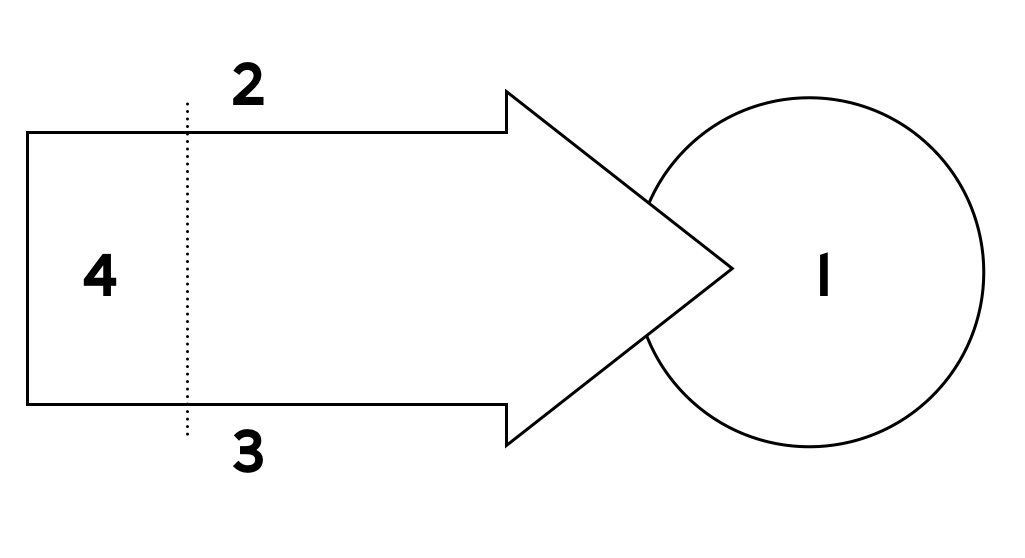
Ask all participants to close their eyes and visualize their life in 1 year (or another time horizon, see facilitator notes below.)
Ask them to explore this future vision. Guide them with questions like:
– Who are you with? Who is around you?
– What have you achieved that you are proud of?
– What are you working on?
– How do you spend your day?
– How do you spend your free time?
– etc.
Tailor these questions to the group you are working with and their particular context.
After the visualization, all participants draw their vision on point 1 on their flip-chart. By drawing, participants make their vision tangible without focusing too much on the details.
After drawing, person A begins interviewing person B.

Person A interviews person B.
First, the interviewer asks their partner to imagine the key factors that supported the vision to be realized.
Remind participants to speak as if they are looking back, describing what helped them realize their vision. They should move back in time from the vision back toward the present day. It could be things like, “I got really good help from my mentor,” “I started to work out regularly,” “I hired an accountant” or “I faced my fear of failure.” Anything that had a positive effect on achieving the vision.
During this step, the interviewer writes down each key factor on a post-it note and placing it at point 2 on the flip-chart of their partner.

Next, the interviewer asks their partner to identify three hindering factors that almost made me fail.
These factors are the things almost made them give up and not realize their vision. This could be, “I overslept and showed up late a lot,” “At first I didn’t dare to quit my job to start something new” or “I almost didn’t tell the person I liked that I had a crush on him.” Again, the interviewer writes these down on post-its and puts them at point 3 on the model.
The interviewer continues asking about the three hindering factors, but shifts focus to what the person did to overcome them. For instance, “I had a friend call and wake me up every morning,” “I trained in a new skill and it led to my new dream job.” The interviewer writes these solutions on post-its and attaches them to the problems on the model.

Finally, the interviewer asks their partner to consider steps they have already taken toward their vision. They might say, "I signed up for this course," or "I've started training in this new skill."
The dotted line represents today and the interviewer writes and adds these post-its to point 4 on the model.
After the first interview is complete, the partners switch and repeat the process.
Each participant's arrow is now full of post-its representing tasks in an action plan to achieve the vision. Whether the time horizon is 3 months or 3 years, the arrow represents a realistic path to get there.
Encourage participants to keep their arrow and even to post it somewhere where they will see it and draw inspiration from it.
End the session with a check-out where each participant shares the next action they will take toward their vision.

The purpose of this simple exercise is to demonstrate three key principles useful for creativity and idea generation: quantity is a condition for quality; building on the ideas of others; the ideas we come up with are usually all the same. The format is simple, with small groups standing and drawing apples. At the end of the exercise the whole group reflects and draws out learnings and reflections.

IDOARRT is a simple tool to support you to lead an effective meeting or group process by setting out clear purpose, structure and goals at the very beginning. It aims to enable all participants to understand every aspect of the meeting or process, which creates the security of a common ground to start from. The acronym stands for Intention, Desired Outcome, Agenda, Rules, Roles and Responsibilities and Time.

A short activity to run early in a program, focused on sharing fears, anxieties and uncertainties related to the program theme. The purpose is to create openness within a group. The stinky fish is a metaphor for "that thing that you carry around but don’t like to talk about; but the longer you hide it, the stinkier it gets." By putting stinky fish (fears and anxieties) on the table, participants begin relate to each other, become more comfortable sharing, and identify a clear area for development and learning.

A team-building activity in which a group is challenged to physically support one another in an endeavor to move from one end of a space to another. It requires working together creatively and strategically in order to solve a practical, physical problem. It tends to emphasize group communication, cooperation, leadership and membership, patience and problem-solving.
This workshop aims to help participants define, decide and achieve their goals. By supporting participants to envision where they want to be in a number of years on a holistic level, and defining the steps that will take them there, participants get a clearer picture of the action they need to take.

This exercise is useful for bringing groups together, to create interpersonal bonds, and to build trust. Participants stand opposite each other and have 30 seconds to give appreciative feedback to the other person. The group rotates until everyone has given feedback to everyone else. It is often used as part of wrap-up activities, to create an energized feeling to leave with.