
move the room with energizers
Tools to inject energy into the process, get people moving, and have fun.
A resource kit you can use to apply creative collaboration and unleash potential in your team or organization.
Tools to inject energy into the process, get people moving, and have fun.

Tools to unleash creativity, discover valuable insights, and develop new products and services.

Tools for personal development, reflection, self-awareness and how to integrate learning and grow.

Tools focused on implementation, and driving and supporting change in organizations.

Tools to build effective teams - foster trust and openness for better collaboration.
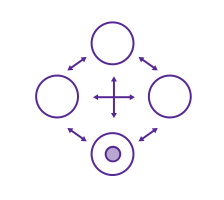
This is a feedback exercise to support participants to deliver feedback that is clear and specific, especially after working in multiple project teams over a longer period of time. The team maps the connections between individuals, then uses specific points of interaction to prompt feedback.
Introduce the exercise. Explain that its purpose is to support team members to give each other more effective and specific feedback by visualising the connections between them.

You can choose to circle more or fewer interactions, depending on the time constraints and the openness of the group.
Either on a whiteboard or large paper on the wall, write up the names of the each members. The names should be scattered around, with space in between each.
Discuss with the team what a useful timeframe for this exercise would be (e.g., 3, 6, or 9 months), based on how long the team has worked together and how recently the team has worked with feedback. Once decided, write the timeframe at the top of the paper/board.

Team members start by mapping out their working relationships to each other. Each member draws lines connecting him/herself to other participants they have worked with within the timeframe using one or two words to encapsulate their interactions, projects, or collaborations.
For example, Erik draws a line connecting his name to Robin, writing “Re-branding Project” on that line. Each member should draw as many lines as possible to as many other members as possible.

Continue until the map is full of connections. Ask individuals to circle three specific points of interaction that they’d like to address through feedback.
Once everyone has chosen their points of interaction, run a session using an appropriate feedback method. Team members can give spoken or written feedback, but as always it must be offered and asked for, given with an I-Message, and taken with humility and maturity.

Once everyone has given feedback, bring the group back together for a short reflection on how the exercise went.


The purpose of this simple exercise is to demonstrate three key principles useful for creativity and idea generation: quantity is a condition for quality; building on the ideas of others; the ideas we come up with are usually all the same. The format is simple, with small groups standing and drawing apples. At the end of the exercise the whole group reflects and draws out learnings and reflections.

IDOARRT is a simple tool to support you to lead an effective meeting or group process by setting out clear purpose, structure and goals at the very beginning. It aims to enable all participants to understand every aspect of the meeting or process, which creates the security of a common ground to start from. The acronym stands for Intention, Desired Outcome, Agenda, Rules, Roles and Responsibilities and Time.

A short activity to run early in a program, focused on sharing fears, anxieties and uncertainties related to the program theme. The purpose is to create openness within a group. The stinky fish is a metaphor for "that thing that you carry around but don’t like to talk about; but the longer you hide it, the stinkier it gets." By putting stinky fish (fears and anxieties) on the table, participants begin relate to each other, become more comfortable sharing, and identify a clear area for development and learning.

A team-building activity in which a group is challenged to physically support one another in an endeavor to move from one end of a space to another. It requires working together creatively and strategically in order to solve a practical, physical problem. It tends to emphasize group communication, cooperation, leadership and membership, patience and problem-solving.

This workshop aims to help participants define, decide and achieve their goals. By supporting participants to envision where they want to be in a number of years on a holistic level, and defining the steps that will take them there, participants get a clearer picture of the action they need to take.

This exercise is useful for bringing groups together, to create interpersonal bonds, and to build trust. Participants stand opposite each other and have 30 seconds to give appreciative feedback to the other person. The group rotates until everyone has given feedback to everyone else. It is often used as part of wrap-up activities, to create an energized feeling to leave with.